Some of the last century’s bravest helpers arrived on four paws. They crawled through wreckage, carried messages through shellfire, and crossed frozen country with medicine that could not wait.
These were real dogs whose service helped people survive extraordinary danger. A few became household names; others deserve another moment in the spotlight.
Our countdown celebrates documented acts from 1901–2000. The order is an editorial tribute, not an official ranking, and the illustrations are clearly labeled historical recreations.
20. Balto — The Final Dash Into Nome

The dog at the finish line became the face of an enormous team effort. In February 1925, Balto led Gunnar Kaasen’s sled team into Nome, Alaska, carrying urgently needed diphtheria antitoxin.
Winter weather had made an air delivery impractical. Volunteers instead organized a relay, passing the precious package from one dogsled team to the next across hundreds of miles.

Balto’s job was to bring that relay home. Kaasen and his dogs arrived early on February 2, completing the final leg of a journey that depended on many mushers and many more dogs.
His story had another rescue in it. Two years later, supporters raised money to remove Balto and six teammates from a traveling exhibition. Cleveland welcomed them into retirement, giving the celebrated working dogs something less dramatic, but thoroughly deserved: a secure home.
19. Brian — The Family Dog Who Earned His Wings

Betty Fetch offered Brian for wartime service with one very clear expectation: she wanted her dog back. In the meantime, the young Alsatian had an extraordinary assignment ahead.
After training at the Army War Dog Training School, Brian joined the 13th Parachute Battalion. He completed the required jumps and parachuted into Normandy in June 1944.
These dogs provided patrol and guard work after landing, bringing sharp senses to troops operating in unfamiliar territory. Getting out of the aircraft was only the beginning of the job.
Brian survived and returned to Betty after the war. His service earned the PDSA Dickin Medal in 1947. One historical detail matters here: the Airborne Assault Museum identifies Brian and the better-known Bing as separate dogs. Brian’s own remarkable record needs no borrowed adventures to make it worth remembering.
18. Beauty — The Rescuer Who Found the Forgotten Pets

While rescue crews searched shattered buildings for people, Beauty helped find the animals trapped there, too. The little wirehaired terrier worked alongside PDSA superintendent Bill Barnet during the London Blitz.
Her first discovery was a cat. Beauty began digging at rubble, and the search revealed a living animal underneath. The terrier had found a way to make herself useful without being formally trained for the task.
PDSA credits her with locating 63 animals during her wartime service. That is an animal-rescue tally, an important distinction from versions that describe her as saving 63 people.
For families already facing bomb damage and displacement, a recovered pet could be one precious piece of home. Beauty received the Dickin Medal in January 1945, recognition for a small dog whose nose kept finding lives that might otherwise have been overlooked.
17. Bulla — Courage on an Ordinary Police Shift

Bulla’s service was far removed from famous battlefields. He was a Leicestershire police dog, working in the same communities where people went shopping, raised families, and expected to get home safely.
In May 1990, officers confronted a man carrying a butcher’s knife and threatening police and members of the public. Bulla was deployed to apprehend him.
The dog was fatally injured during that encounter. Despite attempts to save him, he died at the scene. His place in this countdown rests on that documented act of duty, without an invented tally of lives saved.
Bulla was later honored with a posthumous PDSA Gold Medal, and the UK police-dog memorial records his loss. His story is a sober reminder that a working dog’s courage can be called upon on a familiar street, with very little warning.
16. Horrie — The Little Dog Who Heard Danger First

Private Jim Moody found a puppy in Egypt in early 1941. Before long, Horrie was traveling with Australia’s 2/1st Machine Gun Battalion through a war much larger than he was.
The Australian War Memorial records that he worked as a guard dog and repeatedly gave early warning of approaching enemy aircraft. A little dog’s hearing became a useful alarm system.
Horrie accompanied the unit through Egypt, Greece, Crete, Palestine, and Syria. He survived the sinking of the ship Costa Rica during the evacuation from Greece and was wounded in Crete.
There was room for tenderness amid all that upheaval. In Syria’s cold, the soldiers fitted him with a coat made from a service tunic. Photographs preserve the unlikely sight: a tiny companion dressed for duty, standing among the tents of men who had come to depend on him.
15. Ricky — The Mine Dog Who Stayed Steady
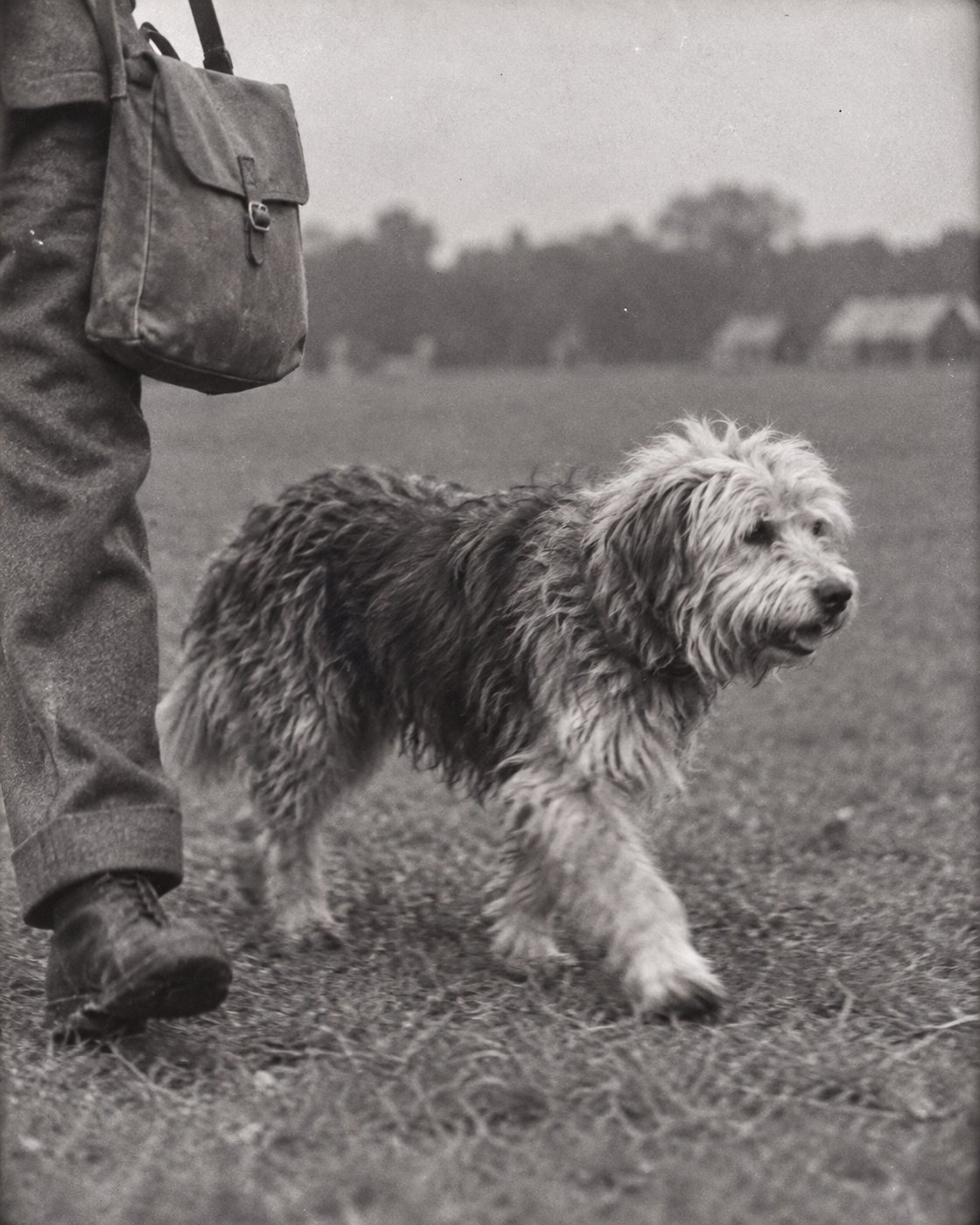
Ricky’s owner loaned him to the Army. Loaned was the important word: Mrs. Litchfield expected her collie to come home when his wartime work was finished.
In December 1944, Ricky and handler Maurice Yielding were clearing mines beside the Noordervaart canal in the Netherlands. Explosives concealed in mud, gravel, and vegetation made every part of the job hazardous.
A nearby mine exploded, wounding Ricky in the head. Yet he remained calm and continued working. His handler credited that steadiness with helping the team get through a situation in which panic could have made everything worse.
This was courage expressed as composure. Ricky received the Dickin Medal in 1947. The Army had wanted to purchase him, but Mrs. Litchfield held to the original arrangement. After his service, the dog who had worked among mines went home.
14. Lucky — A Nose the Jungle Couldn’t Defeat

A dense jungle can hide a person from view. It is much harder to hide every trace of scent from a well-trained tracking dog.
Lucky, a German shepherd serving with the RAF Police, worked in Malaya between 1949 and 1952. With handler Bevel Austin Stapleton, she helped patrols locate insurgents through difficult tropical terrain.
Her recognition also honored three fellow dogs: Bobbie, Jasper, and Lassie. PDSA records that Lucky was the only one of those four to survive their campaign service. The losses give her cheerful name a painful weight.
The dogs’ contribution was shared, and so was the recognition. Lucky’s posthumous Dickin Medal honored the tracker team’s determination and lifesaving work. The award came decades later, but the dangerous patrols that earned it belonged firmly to the middle of the twentieth century.
13. Rags — The Paris Stray Who Carried the Message

Rags began as a scruffy Paris stray and ended up a beloved mascot of the U.S. Army’s 1st Infantry Division. Between those two chapters, he became a wartime messenger.
Signalman James Donovan taught the little terrier to carry messages. When telephone wires failed under battlefield conditions, a dog could provide another way to get essential information through.

The Army’s NCO Journal recounts an October 1918 mission in the Argonne in which Donovan attached a message to Rags’s collar. Both were caught in shellfire and gas, but Rags completed the delivery despite his injuries.
Dog and handler were evacuated to the United States. Donovan died in 1919; Rags lived on, eventually cared for by an Army family. Soldiers continued to claim him as their own, and the once-homeless dog became a living link to the division’s experience in France.
12. Sam — The Peacekeeper Who Held His Ground

Peacekeeping did not mean peaceful work for Sam. In 1998, the German shepherd and his handler, Iain Carnegie, served with the Royal Canadian Regiment in Drvar, Bosnia and Herzegovina.
During one patrol, a gunman opened fire and fled into a bar. Sam pursued and brought him down, allowing Carnegie to disarm and arrest him.
Within days, the team faced another emergency. Civilians sheltering in a compound were threatened by a violent crowd. Sam and the peacekeepers forced their way inside and helped hold the attackers back until reinforcements arrived.
Sam’s courage bought time for people who needed protection. He died in 2000, before receiving his posthumous Dickin Medal in 2003. His citation recognized both incidents, a record of a dog repeatedly doing difficult work beside his handler when the situation was already dangerous.
11. Bamse — The Shipmate With the Thickest Coat

A Saint Bernard aboard a Norwegian minesweeper is difficult to picture as anything but the center of attention. Bamse, mascot of the Thorodd, gave his shipmates more than a memorable silhouette.
PDSA records two separate lifesaving incidents while the vessel was based in Scotland. In Dundee in 1941, Bamse knocked an armed attacker into the water when the man threatened Lieutenant Commander Olav Nilsen.
The following year, a sailor fell overboard. Bamse entered the water, and the man held onto his thick coat as the dog brought him toward the dockside.
For one struggling sailor, that great shaggy coat became something to hold onto. Bamse’s later Gold Medal recognized both rescues and his devotion to the crew. The familiar ship’s mascot had become, in the most practical sense, a shipmate people could depend on.
10. Rip — The Rescued Stray Who Returned the Favor

An air raid left Rip alone and hungry in London’s Poplar district. Air Raid Warden E. King offered the little crossbreed food, and the stray found himself a new circle of people.
King’s Civil Defence colleagues adopted him as a mascot. Then Rip began finding people and animals trapped in bombed buildings, turning up a skill nobody had formally taught him.

The dog who needed rescuing became a rescuer himself. Working alongside the human crews, he used his nose to help locate survivors concealed beneath wreckage.
PDSA says he is believed to have helped save more than 100 people in a year; that remains an attributed estimate, rather than a precise count. His Dickin Medal citation makes the essential point without a number: Rip located many air-raid victims during the Blitz. He had made himself very much part of the team.
9. Ceaser — The Bulldog Who Searched the Somme

Ceaser’s surviving photograph shows a sturdy, long-legged bulldog. His work demanded rather more than a mascot’s appearance at a parade.
He traveled overseas with New Zealand’s Rifle Brigade and handler Thomas Tooman. In Egypt, Ceaser trained as a Red Cross dog before going to France and the battlefields of the Somme.
The National Army Museum describes a harness carrying supplies such as bandages and water. Ceaser searched for wounded soldiers, helping guide those who could walk and carrying messages for those who could not.
In one rescue recorded by the museum, he uncovered the face of a soldier buried by a shell blast, then went for help. Finding one man hidden in the earth could mean everything to that man. Ceaser was later killed in action. The unusual spelling of his name survives on his original collar.
8. Antis — The Dog Who Flew With Bomber Command

Most dogs find a car ride exciting enough. Antis accompanied Czech airman Václav Robert Bozděch on wartime bomber operations.
Their bond began in France and continued after they reached Britain. Historian Hamish Ross, interviewed by Radio Prague, describes Antis flying with a Wellington crew despite regulations that prohibited taking a dog on operational flights.
Antis was wounded during his service, yet his composure made a lasting impression on the airmen around him. The crew drew courage from a companion who stayed beside them through danger.
His story continued after the war. In 1948, Antis helped Bozděch escape across the Czechoslovak border, alerting him to danger as they made their way out. The PDSA Dickin Medal recognized both his wartime service and that later escape. For this pair, getting through one war had not ended the need to rely on each other.
7. Nemo — The Sentry Who Wouldn’t Leave His Handler

On a night in December 1966, Nemo detected enemy troops concealed at Tan Son Nhut Air Base in South Vietnam. His handler, Airman Robert Throneburg, released the German shepherd to attack.
The ensuing firefight wounded both of them. Throneburg was hit in the shoulder, and Nemo suffered a serious facial injury.

According to the National Museum of the U.S. Air Force, Nemo remained beside his handler until the firefight ended. The dog was credited with saving Throneburg’s life.
Nemo lost an eye but survived, eventually returning to the United States. He spent his retirement in a special kennel at Lackland Air Force Base in Texas. His post-recovery photographs show a striking, upright-eared shepherd with a healed closed eye: a recognizable individual, and a reminder that the cost of service was carried by dogs as well as people.
6. Stubby — The Stray Who Became a Soldier’s Companion

Stubby turned up around soldiers training at Yale in 1917. The small, brindled stray formed a bond with J. Robert Conroy and eventually accompanied him to France with the 102nd Infantry.
The Smithsonian’s account records that Stubby endured a gas attack and was later wounded by shell fragments. It also recounts his capture of a German soldier during his time with the unit.

He became far more than a camp mascot to the men who knew him. His familiar presence traveled with them through a war that brought danger and separation on an enormous scale.
After the war, the familiar nickname Sergeant Stubby followed him home. He accompanied Conroy to Georgetown and became a university mascot. The little dog’s next crowd was cheering from the sidelines rather than serving in the trenches.
5. Smoky — The Tiny Terrier Who Fit Where Soldiers Couldn’t

Smoky looked small enough to tuck into a helmet. At an airfield in the Philippines, that size became a remarkable advantage.
Engineers needed to run a communications line beneath a runway. Digging it up would take time and expose men to danger. An existing culvert offered another route, but it was narrow and partly obstructed.
With a light line attached to her collar, the Yorkshire terrier worked through the pipe toward the voice of her owner, Bill Wynne. Her passage made it possible to pull the communications line through.
The smallest member of the group could do the job the others couldn’t. The Australian War Memorial’s account describes a culvert about 70 feet long and eight inches wide. Smoky’s service also included bringing comfort to hospitalized soldiers, giving the tiny dog a second, much gentler way to help.
4. Chips — The Family Pet Who Charged the Gun Position

Before Chips went to war, he belonged to the Wren family in New York. The mixed-breed dog entered Army service and deployed overseas with handler Private Rowell.
During the invasion of Sicily in July 1943, their unit came under machine-gun fire. Chips broke away and rushed the position.
PDSA’s account records that four enemy soldiers emerged and surrendered. Chips had suffered burns and other injuries, but his action had helped silence the gun threatening the men around him.
It was a startling intervention from a dog who had once been somebody’s pet. He continued serving and ultimately returned to the Wren family after the war. Decades later, a posthumous Dickin Medal recognized what he had done in Sicily. His homecoming photographs offer the happier ending to the battlefield story: Chips back within reach of his family’s hands.
3. Gander — The Newfoundland Who Carried the Grenade Away

Gander was a large Newfoundland serving as mascot to the Royal Rifles of Canada. In December 1941, he was with the Canadian soldiers defending Hong Kong.
PDSA’s account credits him with repeatedly confronting attackers and helping protect wounded men. His final act came when a grenade landed near a group of soldiers.
Gander picked it up and carried it away. The explosion killed him, but moving it away from the men spared them its blast.
The documented action is extraordinary enough without pretending to know what he understood. A dog cannot explain his decisions to us. The soldiers could, however, describe what he did and what it meant to them. In 2000, Gander received a posthumous Dickin Medal, nearly six decades after the big, shaggy companion from Newfoundland performed the act for which he is remembered.
2. Togo — The Veteran Who Took the Hard Country

Togo was already twelve when the 1925 emergency relay to Nome put his experience to an exceptional test. Leonhard Seppala trusted the veteran lead dog with a long, dangerous part of the journey.
The mission was to move diphtheria antitoxin across Alaska through severe winter conditions. Every handoff depended on another team reaching the right place with the medicine still moving toward Nome.
The National Park Service identifies Togo as a crucial participant and emphasizes the demands of Seppala’s stretch of the relay. Years of experience mattered more than youth.
Balto’s team made the final delivery, but that does not diminish Togo’s contribution—or the work of the other mushers and dogs along the route. His story is especially satisfying for anyone who has loved an older working dog: a trusted veteran, still doing a difficult job when people urgently needed him.
1. Judy — The Prisoner of War Who Helped Others Survive

When the gunboat HMS Grasshopper sank during the retreat from Singapore, its canine mascot survived with members of the crew. Stranded on an island, Judy dug down to fresh water.
For thirsty survivors, the English pointer’s discovery was immediately useful. But her ordeal was only beginning. Judy later entered captivity in Sumatra, where she formed a lasting bond with airman Frank Williams.

Williams shared his rations with her and secured her recognition as a prisoner of war. Judy became a source of companionship and vigilance amid years of deprivation.
She survived another sinking and the harsh conditions of captivity before liberation in 1945. Her Dickin Medal citation recognized the lives she helped save and the morale she sustained among fellow prisoners. Judy survived the war with Williams, bringing this countdown to a dog whose courage was measured in years as well as moments.
Sources and historical context
This countdown draws on museum collections, military histories, PDSA award records, and a historian’s account. Every act described falls within 1901–2000, even when an award came later. The order is an editorial tribute. Historical accounts sometimes differ, so uncertain totals are attributed and disputed details are left out.
Balto — Cleveland Museum of Natural History; Brian — Airborne Assault Museum; Beauty — PDSA; Bulla — K9 Memorial UK.
Horrie — Australian War Memorial; Ricky — PDSA; Lucky — PDSA; Rags — U.S. Army NCO Journal, September 2011, pp. 32–33.
Sam — PDSA; Bamse — PDSA Gold Medal roll; Rip — PDSA; Ceaser — National Army Museum, New Zealand.
Antis — Radio Prague interview with historian Hamish Ross; Nemo — National Museum of the U.S. Air Force; Stubby — Smithsonian National Museum of American History; Smoky — Australian War Memorial, Places of Pride.
Chips — PDSA; Gander — PDSA; Togo — National Park Service; Judy — PDSA.
Additional records: PDSA Dickin Medal roll; Smoky’s hospital visits, Places of Pride.
Archival photo credits
Judy — original historical photograph: Unknown photographer / Imperial War Museums. Public domain; UK government photograph before June 1957, Crown copyright expired worldwide. JPEG encoding and proportional downscale where needed; original composition retained.

Nemo — original historical photograph: U.S. Air Force. Public domain; official U.S. government photograph, expressly stated on museum page. JPEG encoding and proportional downscale where needed; original composition retained.
Rags — original historical photograph: U.S. Army Signal Corps. Public domain; official U.S. Army photograph. JPEG encoding and proportional downscale where needed; original composition retained.

Balto — original historical photograph: Unknown photographer / Cleveland Press Collection, Cleveland Memory Project. Public domain in United States; published 1925. JPEG encoding and proportional downscale where needed; original composition retained.

Rip — original historical photograph: Ministry of Information Photo Division / Imperial War Museums, D 5937. Public domain; UK government photograph before June 1957, Crown copyright expired worldwide. JPEG encoding and proportional downscale where needed; original composition retained.

Stubby — original historical photograph: Photographer unrecorded, via Wikimedia Commons. Public domain in United States; historical 1918–1921 photograph. JPEG encoding and proportional downscale where needed; original composition retained.
